01 / Definition
What is a microgrid?
A microgrid is a group of interconnected loads and distributed energy resources within clearly defined electrical boundaries. It acts as a single controllable entity with respect to the grid and can operate either grid-connected or in island mode.
Based on common IEC and U.S. Department of Energy definitions.A microgrid is not simply solar panels plus batteries. It requires a defined boundary, coordinated resources and the ability—where the design calls for it—to balance supply and demand while maintaining voltage and frequency.
02 / System architecture
What makes up a microgrid?
A typical architecture has energy, conversion and distribution, control and communications, and load layers. The controller forecasts, optimizes and dispatches resources continuously.
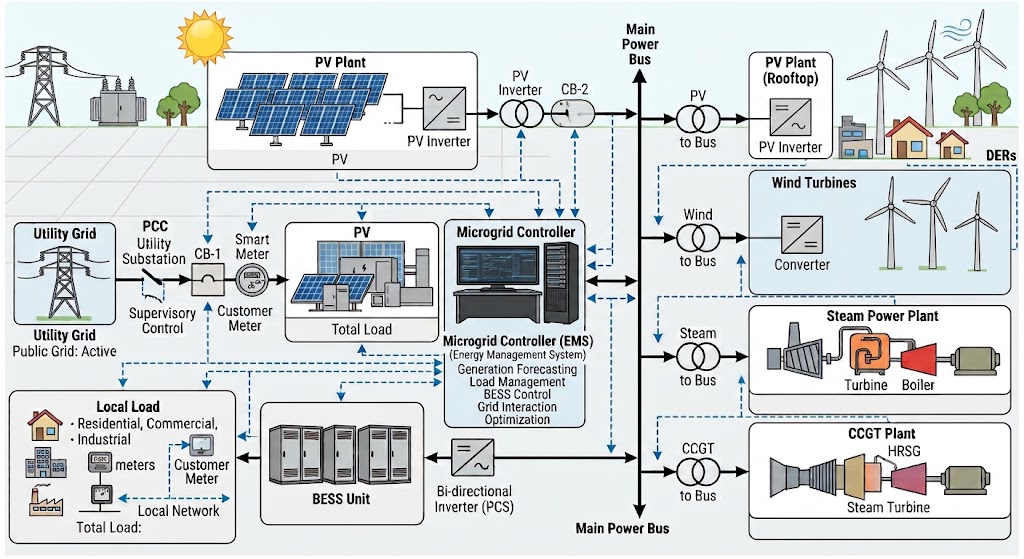
Solid lines show main power paths; blue dashed lines show measurement, monitoring and control signals. The PCC is the grid interface, while a bidirectional converter allows the battery to charge and discharge.
03 / Why build
Why build a microgrid?
Most microgrids have more than one objective. A bankable project quantifies local pain points and combines resilience, cost, capacity and decarbonization benefits.
Power resilience
During storms, earthquakes, wildfires, equipment failures or grid outages, the microgrid can separate and support critical loads with storage and dispatchable generation.
Define critical loads, required power, duration, black-start capability and acceptable interruption time.Energy cost
Storage, flexible loads and local generation can respond to time-of-use and demand charges to cut peaks and increase self-consumption.
Savings depend on load shape, tariff design, battery degradation, fuel and O&M—not installed capacity alone.Renewable integration
Storage, controllable generation and demand response absorb solar and wind variability, reduce curtailment and limit grid impacts.
Assess seasonal resources, forecast error, minimum stable generation and low-sun or low-wind backup.Capacity and connection
Local supply, peak shaving and load management can reduce demand on constrained feeders or substations and support faster load growth.
Any deferral of network upgrades must be accepted by the utility and comply with connection and reliability rules.Decarbonization
Renewables, electrification and optimized dispatch reduce fossil-fuel use and provide measurable evidence for corporate climate targets.
Distinguish on-site and purchased-power emissions and apply local grid factors and lifecycle boundaries.Remote power
Hybrid renewable-storage systems can displace costly diesel on islands, mines and remote communities while improving service hours and quality.
Account for logistics, weather, remote O&M, spares, training and long-term ability to pay.04 / Main types
How are microgrids classified?
Connection to the utility and planned or emergency island capability
Connection method, conversion stages and control strategy
Load profile, reliability, ownership and business model
Dispatchable share, storage need and emissions
Coordination, shared reserves and wider dispatch
05 / Value
Value goes beyond backup power
Assess value under normal operation, abnormal events and external grid services—not by equipment cost alone.
Energy and demand-charge savings, fuel reduction, deferred network investment and market revenues.
Less downtime and business loss; continuity for healthcare, data, communications and water.
Lower emissions, better energy access, local autonomy and disaster recovery.
Results vary with tariffs, outage probability, market rules, fuel cost and load profile. Returns from another project cannot be copied directly.
06 / Rules & standards
Which rules matter?
Microgrids cross generation, distribution, storage, consumption and trading rules. Licensing differs by country, but every project should check:
Planning, operation, protection, dynamic control, energy management and monitoring.
Functional specification and testing considerations for microgrid controllers.
Utility connection, storage, protection and market rules remain the direct compliance basis.
07 / Global development
Where is the global market heading?
Critical facilities, campuses and military sites are expanding toward community resilience, data centers and networked microgrids.
Projects increasingly connect energy communities, distributed flexibility, markets and island decarbonization.
Japan, Korea, Singapore and Australia emphasize resilience, industrial sites, storage and grid services.
Renewable mini-grids remain important in weak-grid areas while commercial and industrial solar-storage grows.
Energy access and diesel displacement lead; affordability and durable operations remain decisive.
Lower storage costs, digital control, grid-forming inverters, EVs, virtual power plants and networked microgrids are turning isolated backup systems into flexible grid nodes.
08 / Risks
Projects rarely fail because of one device
Failure is usually systemic: sizing, integration, commercial assumptions and operations interact.
Wrong sizing, poor protection coordination, unstable controls, failed black start or incompatible interfaces.
Load and tariff forecast errors, fuel changes, double-counted revenue and understated O&M.
Permitting and interconnection delays, market-rule changes or limits on third-party sales.
Unclear vendor responsibilities, weak integration and incomplete acceptance testing.
Battery degradation, missing spares, insufficient skills and weak performance monitoring.
Unauthorized access, ransomware and supply-chain vulnerabilities in control and communications.
09 / Delivery pathway
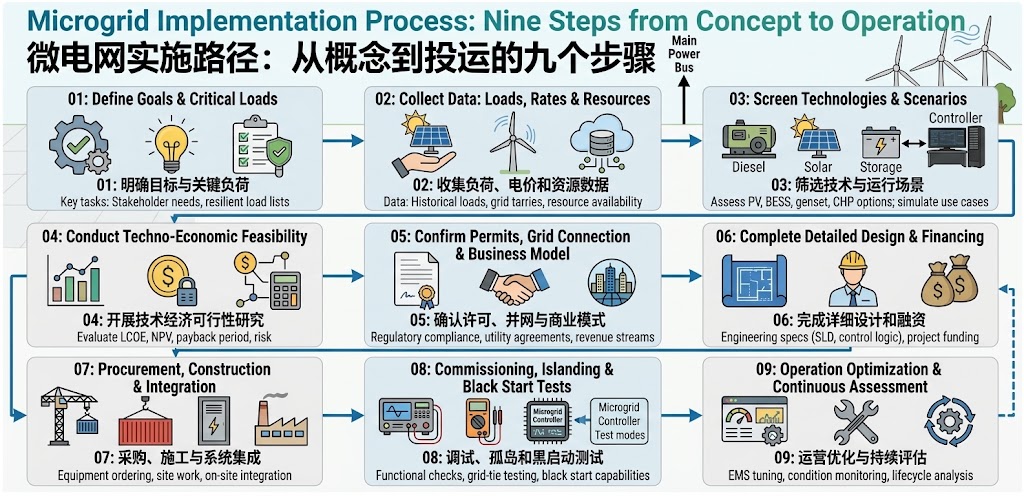
Nine steps from concept to operation
Select any card to see the work and main output; select it again to return.
10 / References